Hello, Lansing Common Football Club fans. I’m Charlie Tuley, and I’ve been helping the Lansing Common coaching staff this summer by doing some analytics and data tracking for the team. I took on this job as an internship gig for credit toward the University of Michigan Sport Management program. As a 2019 graduate of Haslett High School, I’m a proud member of the Lansing community. I, for one, am so happy that there is a men’s football team back in the city of Lansing, and I’m even happier that I could be a part of the club’s inaugural season.
Though it wasn’t my main focus, I spent quite a bit of time tracking all of the shots that Lansing Common took (and had taken against them) this season. At the beginning of the season I had two main goals that I had hoped would come from recording all of the shot locations: to see if the Common players would focus on shooting from certain areas of the pitch more as the season went on, and to create the world’s most basic (yet still functional) Expected Goals model.
For those that aren’t familiar with the Expected Goals concept (or xG as it’s better known), it’s all about calculating the probability that a shot finds the back of the net based on where the shooter is on the field, where the nearest defenders are, and how well the shot was taken. Building an Expected Goals model also requires you to have A LOT of shots (over 1,000), and over the course of the season I only recorded 351.
Needless to say, I didn’t end up making the xG model, both due to the lack of recorded shots, and the lack of information that I had about each shot (I only made note of the shot’s location, who took it, and who assisted it). However, I still have quite a few interesting takeaways (and some even more interesting visualizations) from the data that I have. It was also very helpful on a game-to-game basis to see where the team gave up shots from and how this shifted throughout the season and with different players in the lineup.
Before I get into it though, I do have to make a disclaimer: I’m missing data from some of the games. Due to the lower-quality video from some of the team’s away matches, I wasn’t able to pull shooting data from their streams. Therefore, everything I talk about for the rest of this article will be excluding data from the away matches against Inter Detroit, Michigan Stars U23, Livonia City FC, and West Michigan Bearings. However, I do have data from three of the four friendlies that the team played, so it evens itself out.
Creating data visualizations has been a hobby of mine for quite some time, and it’s how I first broke onto the scene of soccer analytics. And while I don’t have anything groundbreaking here (purely because I don’t have the time to manually track every bit of data from every Lansing Common match), the focus of this article will be on the team’s shot maps, which are still very insightful and interesting to look at.
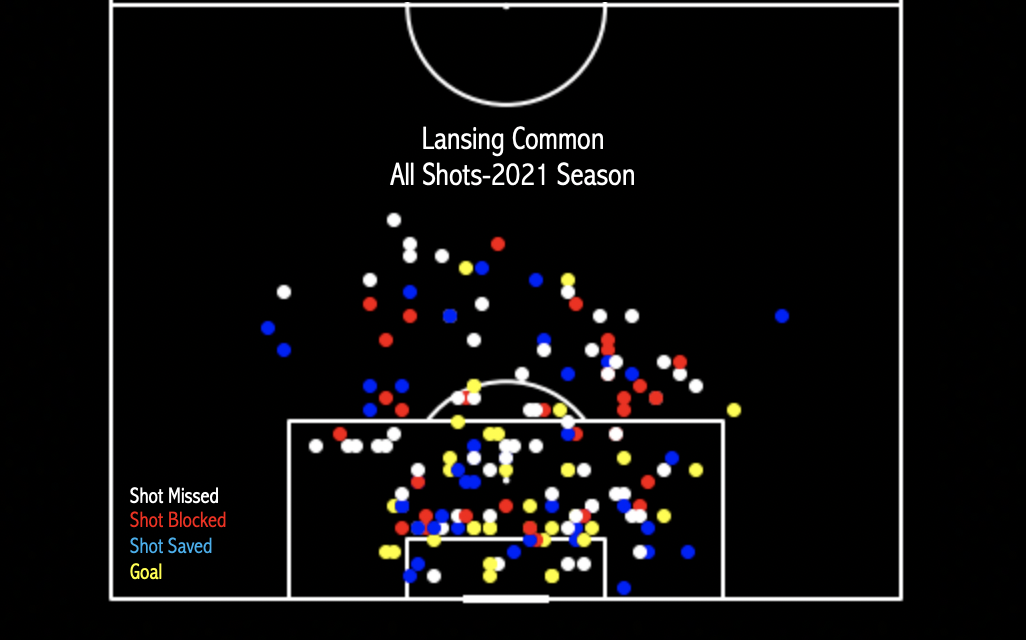
The first shot map that I’ve prepared is very simple- it’s every shot that I recorded this season (for reference, all shot maps will use the same key, found in the bottom-left corner of the image). There’s not a ton that can be taken away from this map, it’s really quite cluttered, other than the Midwest Premier League players as a whole take far too many shots from outside the penalty area. While there is something to be said for teams having to defend differently (more aggressively) when facing a team that shoots from range, the probability of these shots finding the back of the net is quite low.

Let’s filter the data down a bit, shall we? This next map is limited to the shots taken by Lansing Common players this season. As you can see, our Robins are genuinely fantastic at shooting from outside of the penalty area. They’re making me eat my words a bit. Maybe teams should only take shots from outside the box if they have players that are capable of scoring from those positions? Five of the six goals that I recorded from outside of the penalty area came from Lansing Common players. Either they were very good at shooting from range, or our opponents were not. My guess is it’s a bit of both.
As I mentioned earlier, I wanted to analyze if the Common players focused their efforts at shooting from certain areas as the season went on. There wasn’t any definitive evidence that the players actively tried to get into certain positions, but this shot map does have a couple of “high intensity areas.” Most notably, the area above the left side of the six-yard box, just to the left of the penalty area, and above the top-right side of the penalty area. While none of these areas yielded many goals for the Robins (aside from the area just outside the six-yard box), it shows that certain Common players did target these locations.

Next, I’ve narrowed down the shots once again. This time we’re only looking at Lansing Common’s top scorer (and fellow Haslett High School alumnus), Shady Omar. While Shady proved that he can score from just about anywhere this season (including brilliant, Cristiano Ronaldo-esque freekicks), he definitely has a niche spot- the right side of the six-yard box. Whether his teammates are finding him with crosses, or he’s acting as a poacher and tapping in loose balls, Shady does quite well at finishing from close range. Also, quick note, I went back and manually pulled Shady’s goals from the matches that had low-quality recordings, so all of his goals (but not all of his shots from those matches) can be seen here.

Finally, I wanted to share a look at the team’s shots taken in the final leg of the game. Below is a visualization of the team’s shots taken after the 75th minute in all of their matches. The squad often waited until late in the game to grab their winning goals, and this graphic really illustrates that.

Many different visuals can be made with the shooting data I’ve recorded, and I don’t want that data to go to waste now that the season’s over. I’m willing to share my spreadsheets with anyone who’s interested, and I’d happily walk them through the Python code that would allow them to manipulate it. Also, I’ll open up a request line if any of the players would be interested in seeing their personal shot maps (or ‘assisted shot maps,’ so players can see the locations of the shots that they assisted). Feel free to shoot me a Twitter direct message at @analyticslaliga, or email me at ctuley@umich.edu.
I want to thank everyone on the board of Lansing Common FC and the coaching staff for allowing me to do this kind of work and for bringing this amazing club into existence and making it function so well in its first season. Most importantly, I want to thank the fans of Lansing Common. Since, above all else, I am a football fan, it’s incredible to know that there are so many like-minded people in the Lansing area. Football is nothing without the fans, and this club has some of the best.